Whether you have debt or not, having your own debt strategy is key. If you want to pay off your debt, pay it down, or just get more strategic with it, start here. For too long, getting out of debt has been talked about in an overly simplified way, and it’s not working for folks like you. A lot of financial experts do this because they think you can’t handle complex situations or think critically about your money. I beg to differ. You can figure out how to get out of debt with a strategy that works for you.
Why should you get out of debt?
What if I told you that while getting out of debt tends to be the thing you think you want, it’s not the actual goal you have?
Debt can be a problem, yes, and you may want to prioritize paying it off or paying it down to get into a better position.
But that better position is the goal, and getting out of debt is just the method.
In other words, getting out of debt is a strategy that may be necessary to reach the goal you actually have.
I realize this is a pretty big shift from how most financial experts think and talk about debt.
What I’ve seen working 1:1 with clients is that when you shift your perspective on debt, the change is powerful.
All too often, when someone has the goal of paying off debt, they think about it through the lens of running away from the debt, or running away from the bad situation they think they’ve put themselves in.
But what if paying off debt was more about what you are running toward?
You may read that and think, “Isn’t it the same thing?”
I promise it’s not.
When I meet with clients, I’m looking for one thing: the plan that creates the most buy-in for you.
Your buy-in, your desire to work the plan and get results, is everything.
The difference between “running away from your debt” and “running toward the future you want” is the difference between getting out of debt out of fear and shame and getting out of debt because you’re inspired and excited about your future.
That second one means you’re getting out of debt because it’s one step toward your bigger, more exciting goals in life.
Ask yourself if you’re getting out of debt with the thought, “I have to do this or else,” or, “Debt is bad. I’ve got to clean this up.”
OR
Ask yourself if you’re getting out of debt with the thought, “I want to do this because my future is mine to create!”
It’s the difference between obligation and desire.
It’s the difference between fixing past problems and reaching for more for your future.
Do you want to pay off your debt because you made mistakes and feel like you’re bad with money?
Or do you want to pay off your debt because your life is good, and you want it to be great?
Do you want to pay off your debt because you’re thinking about the past and feeling shame and embarrassment about how you got there?
Or are you paying off debt because you and your future are worthy of more, and you know debt isn’t part of that future?
Think about all your attempts to pay off your debts up until now. I’m guessing they’re filled with a lot of thoughts like “we should” or “we have to” or “this debt is killing us,” and feelings of shame, frustration, or guilt.
I bet it’s all heavy.
Heavy and exhausting.
The result is a vicious cycle. You make progress on the debt for a little while, then something happens (maybe a car repair or that soccer registration you forgot all about), and the balance goes right back up.
Making decisions from desire is a much more sustainable approach.
And it’s way more enjoyable, too.
If you have debt, are you in trouble?
I can’t stand how most financial experts talk about debt.
Like I really, really hate it.
There’s an overarching assumption, or insinuation, that someone who has debt isn’t financially smart or stable.
When I meet someone new and tell them I’m a financial coach, I’m often met with something like:
“Oh… I’m doing pretty good with my money, I don’t have any debt.”
Debt, and whether or not someone has it, has become a stand-in for a person’s capabilities, financial position, or future potential.
The thought many people carry is:
If you have debt, you’re in trouble. If you don’t have debt, you’re doing good with money.
So many things are wrong with this.
Over the years, I’ve had a handful of clients who are amazingly successful with money. They make smart, calculated decisions, they never take on too much risk, and yes, they sometimes use debt in a very strategic way.
They are financial rockstars and they have debt.
And I’ve had a whole bunch of clients who never, ever use debt (or never used it again after getting out of it). They, too, are smart, strategic, and growing their wealth in a way that feels really great to them.
They are financial rockstars who choose to reach their goals without debt as one of their strategies.
Debt is not the determining factor of how strong, solid, savvy, or confident someone is with money.
I cannot ignore what I’ve seen with my own eyes.
Please know, I’m not saying “YAY! DEBT IS AWESOME! HERE’S A CREDIT CARD FOR YOU! AND A CREDIT CARD FOR YOU! CREDIT CARDS FOR EVERYONE!”
Absolutely not.
The key is that to use debt successfully, you have to be strategic, intentional, and self-aware. I wish we’d just say that.
“Having debt” and “leveraging debt” are two very different things.
By positioning debt as some “great evil,” being “debt-free” has become a badge of honor, or some arbitrary marker of success, and I think that can actually be quite dangerous.
Michael and I don’t just have debt. We leverage it.
We have an auto loan at 0.9% interest. We took it at a time when that same money could earn 4.25% sitting in savings, so we borrowed instead of paying cash for the car.
We use credit cards as part of how we manage our money. We earn points, and I pay the balance every Friday.
We have a mortgage.
We have a rental property that also has a mortgage (at an interest rate in the low 4s), and it cash flows over $1,000 a month. We put that money into our investments.
We have debt because when I looked at our other financial goals, leveraging debt actually sped up our ability to reach them.
We’re strategic and intentional about how and when we use it. I accept the added responsibility that comes with choosing to leverage debt, and it’s something we talk through with clients, too.
We choose to leverage debt because it works for us, and I’m proud to say I’m a financial rockstar too.
Why can’t you get out of debt?
Debt is one of the top three financial challenges people come to me with.
The other two are struggles with:
- Saving money. Clients say, “I want to save more,” or, “I can’t seem to save money.”
- Spending money. Clients say things like, “I’m overspending,” “I don’t know where my money is going,” or, “I need to keep my spending in check.”
Chances are, if you have debt, it isn’t just a number. It feels like a heavy weight on your daily decisions, your long-term dreams, and maybe even your self-worth.
If you have debt, you likely have a lot of questions about it. Things you’re trying to figure out, like:
- Does the order I pay off my debts make any difference?
- Which one should I pay off first? Will one have a bigger impact than another?
- How do I tackle these?
- Is there a way to pay less interest and otherwise manage the debt better while I’m tackling it?
- How do I make progress on my debt while still living and enjoying life?
These are all important to figure out, but they’re not what’s most important. Before I tell you what the REAL problem is, let me tell you what it’s not.
It’s not that you’re bad with money.
Your debt is not a determining factor of how strong, solid, savvy, or confident you are with money. I’ve seen people from all walks of life, with all kinds of backgrounds and education levels, wrestle with debt.
Debt is universal, and it says nothing about who you are, what you’re capable of, or what your future potential will be.
It also has nothing to do with your discipline.
Some of the most disciplined people I know, people who get up at 5am every day and never miss a deadline, still find managing their money tricky. Even the most ambitious and disciplined people can find themselves in debt.
So then what is it? What’s the real culprit?
It boils down to clarity, or more accurately, a lack of it.
Your debt happened because you couldn’t see your money clearly.
Think about what your checking account actually looks like.
You have transactions coming out every day or every other day. Sometimes it’s $55, sometimes it’s $7, and sometimes there are five transactions in one day. Some days your paycheck comes in, and on those same days four bills clear.
Then there’s a whole bunch of expenses that don’t happen every month (in SpendFirst, these are your SpendFuture expenses), and they feel like a smack in the face when they come due: your annual car registration, the kids’ upcoming dance recital, the family vacation you planned months ago, the new car tires (just to name a few, I could go on forever).
Some months are okay and you think, “Alright, we can do this, it’s not bad,” and maybe that month you pay extra on your debts or move a little money to savings. You sigh. You really needed a month where you could get ahead.
Then a hard month comes, the kind where a whole bunch of those expenses come due at once. You have to use the money you just moved to savings, or you use your credit card, just to get by.
Either way, your progress the month before feels pointless. Two steps forward, two steps back.
Rinse and repeat. It’s exhausting and disheartening.
You probably already know all of these moving pieces are connected. If you spend money today, you’ll have less of it tomorrow.
But exactly how much can you spend today before you won’t have enough for what’s coming up next week or next month?
What is that exact dollar amount, and how is the decision you’re making today connected to the decision you’ll make with your money in the near future?
Not having that level of clarity is where the real issue is.
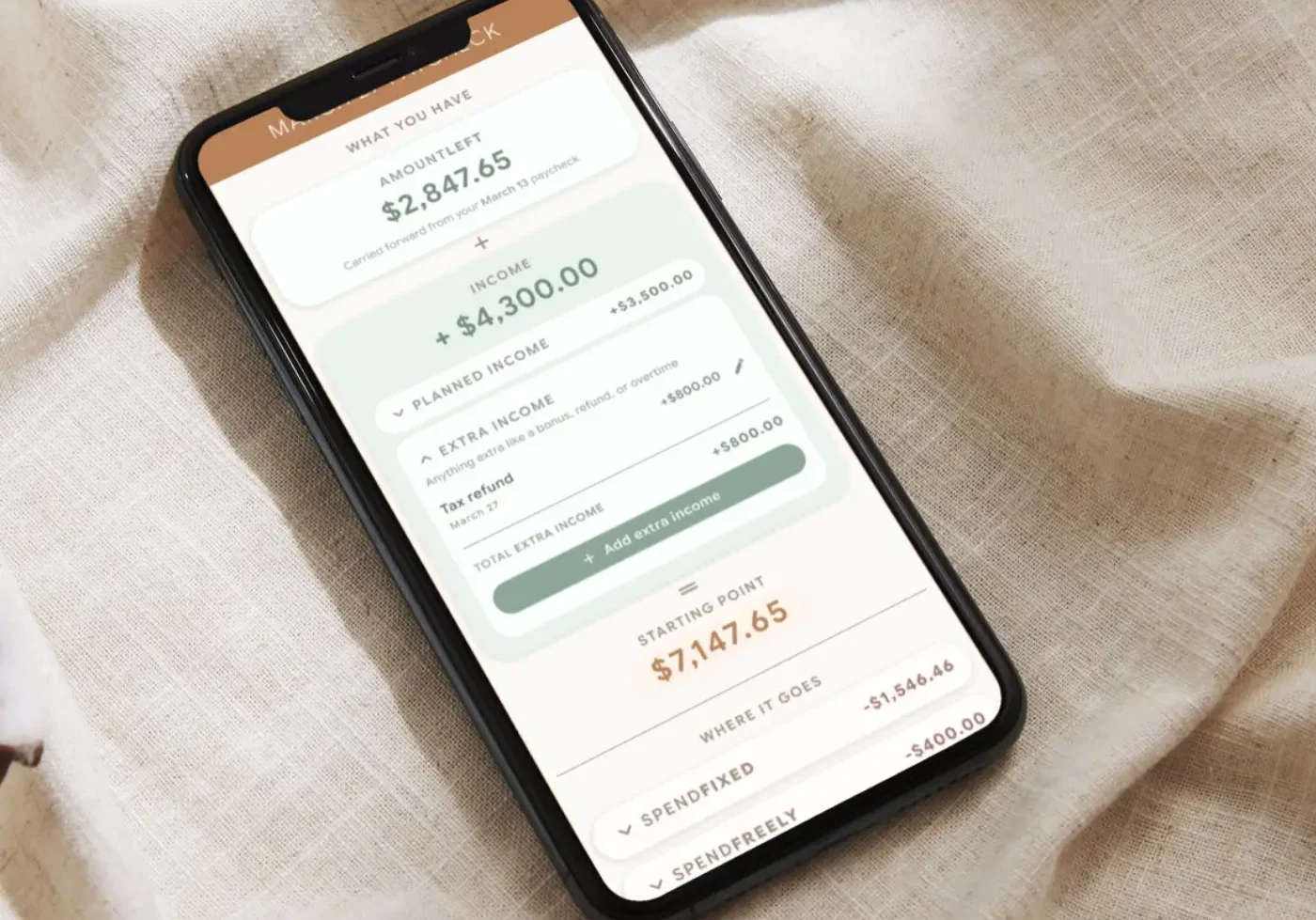
You don’t have that precision. You don’t have complete clarity. And your bank balance won’t give it to you, because it only shows what has already cleared. In SpendFirst, that exact number is your AmountLeft: what will actually be in your main checking account after everything committed to this paycheck clears.
If it were easy to see the impact of your decisions, everyone would make better financial decisions. I certainly don’t believe people are walking around thinking, “Well, this is stupid. I know I don’t have the money, I know I shouldn’t buy this, but I’m gonna do it anyway.”
I think most people are thinking, “Okay, I think this is okay. I don’t really know for sure, but I’ll figure it out. I’ll be fine.”
Sometimes it is fine, but not every time.
You might not really know how it will work out, or how you’ll figure it out… but imagine if you did. Imagine having complete clarity and confidence about how each decision affects your money. You’d make much more empowered decisions, right?
If you could see how the decisions you’re making today really affect you, you’d be able to plan better for what’s coming, whether it’s the unexpected stuff, the big purchases, or the goal you’re working toward.
You’d have a better sense of control, so you can be more prepared and feel more confident making everyday decisions.
Instead of focusing on your debt, ask yourself, “How can I get more clarity on all the moving pieces of my money?”
Solve that problem first, and watch what happens to your debt.
This is where I start with every client. When I look at your numbers, a picture starts to form in my mind. I consider it my job to describe that picture to you so it’s just as clear in your mind as it is in mine.
The best part? Once you see it, you can’t unsee it.
And then it gets so much easier to see the solutions and strategies that will finally help you stop living paycheck to paycheck and make real progress.
I’m not saying debt isn’t a problem. I’m saying it’s not the problem.
How to pay off your debt
If you’re reading this, chances are you have debt, and you’d like to not have debt.
Before you can figure out which payoff strategy will work best for you, there are four parts of your financial strategy to look at first.
All too often, people are so focused on paying off their debts (no thanks to how experts tend to talk about it) that they skip over these really fundamental steps.
But these steps are what keep you from ending up back in debt after you’ve paid it off, so I promise, they’re worth tackling first.
Step 1: Keep some extra money in your checking or savings accounts
I know you’re excited and ready to be done with your debt. But if you take everything out of your checking or savings account today and throw it at your debt, and tomorrow your car breaks down, how will you pay for it? If the answer is your credit card, you’re putting yourself in a vicious cycle that is not only financially devastating, but mentally and emotionally devastating too.
It’s false progress. When you do this, you don’t really have the money to pay down your debt that aggressively. Here’s the mantra I want you to adopt:
It is better to make slow but true progress than fast but fleeting progress.
Step 2: Make sure you’re ready for upcoming expenses
Chances are you have a category of expenses that causes you the most stress and is the biggest reason your debt balances grow. In SpendFirst, these are your SpendFuture expenses.
These are the expenses that don’t happen every month, but when they happen, they happen big. Just when you think you’re gaining traction or getting ahead, one of them comes due.
They cause the most stress because they create the biggest swings from one month to the next, and most people aren’t ready for them. They cause you to scramble because you’ve just got to “figure it out” when they happen. If one has already put you behind, here’s how to get current on past due bills without falling further behind.
Think car repairs, travel, gifts, or annual bills like your car registration or insurance (if you pay it every six months or once a year).
Before you start throwing extra money at your debts, make sure you’re setting money aside each paycheck for these, so they don’t end up on a credit card when they happen.
You can see how I recommend planning for these here.
Step 3: Strengthen your savings strategy
When you’re in debt, it can be hard to see the connection between your income, your expenses, and your savings. That’s because people naturally get hyper-focused on their debt.
But your savings is what lets you weather financial storms, and it’s ultimately what keeps you on the path to getting out of debt despite bumps in the road. If you’re stuck on whether you should save or pay off debt first, the answer is to do this step before you speed up.
Step 4: Recognize that your buy-in and excitement determine your trajectory
There is no one right way to get out of debt. Some people want to pay it off as fast as possible and will sacrifice a lot to hit that timeline. Others want to get out of debt but live life in the process.
When you feel excited about the payoff method you choose, you get:
- Greater commitment
- Better problem-solving
- More creativity
- Stronger follow-through
And all of those lead to faster progress and a better chance of success.
Your trajectory is determined by your enthusiasm, not just by the math.
Now you’re more prepared
Once you’ve committed to those four parts of your financial strategy, you can start tackling (paying extra toward) your debt.
Start here: make a list of your debts
First, you’ll want total clarity on what you’re working with. So make a list of your debts. Include:
- Name of the debt (e.g., Chase, Discover)
- Balance
- Interest rate
- Minimum payment (not what you’re currently paying, but the minimum you’re required to pay)
- Any special notes, like an interest rate that’s about to change or added fees
Once you have your debts written out, you can choose the best method for paying them off.
Which debt payoff method is best?
Chances are you’ve heard a lot of mixed advice about the best way to get out of debt. Maybe you heard you should pay off the one with the highest interest rate first, or the one with the lowest balance?
Below are the four payoff methods I use most often with clients and who each one is best for, so you can decide on your plan of attack.
The right one for you depends on your situation. You may feel most motivated paying off debt as fast as possible, no matter the sacrifice. Or you may need a quick win to stay motivated. Or you may have a debt that’s really weighing you down or causing a lot of stress, so prioritizing that one makes sense.
There’s a payoff strategy for each.
But first, getting your debts organized is where you start. It’s impossible to know which method will work best for you without a snapshot of your debts in front of you.
And remember, if you are getting out of debt, you’re doing it right.
Debt payoff strategies
There are four major debt payoff strategies, listed here in no particular order.
If you want to figure out which strategy is best for you, take the free Debt Payoff Personality Quiz.
Snowball
The Snowball method prioritizes paying off your smallest debt first, then rolling that payment into the next smallest.
How it works: Put your list of debts in order from lowest balance to highest, ignoring interest rates and payment amounts. Pay the minimums on every balance except the lowest one, and put all your extra money (your SpendFlex) toward that debt until it’s paid off. Then put all your extra money toward the next lowest balance, and so on until you’re debt-free.
Who it’s best for: This method works best if you want to get out of debt but have a lot of doubt about whether it’s possible. If your motivation comes and goes, targeting the smallest debt gives you a quick win to help you stay motivated. Paying off smaller debts quickly confirms that what you’re doing is working.
If you have a bunch of debts and they feel overwhelming, like a lot of “financial clutter” with minimum payments and due dates to keep track of, and you can wipe out some of them quickly, this strategy could be best for you.
Avalanche
The Avalanche method prioritizes your highest interest rate debts first.
How it works: Put your list of debts in order from highest interest rate to lowest, ignoring balances and payment amounts. Pay the minimums on all your lower-rate debts and put the most you can toward the debt with the highest interest rate.
Who it’s best for: This method works well if you’re driven to get out of debt and don’t need a quick win to stay motivated. It’s also a fit if you’re motivated by financial gains, saving money, or doing things the most mathematical way. This strategy pays off the debt that’s costing you the most in interest first, which might be really motivating for you.
If you have a bunch of debts and one interest rate is really high compared to the others, or if your balances are all about the same, this strategy could be best for you.
Highest Payment
This strategy is favored by Rich Dad Poor Dad author Robert Kiyosaki. You list your debts from highest payment to lowest (excluding real estate) and pay off the highest payment first.
How it works: Put your list of debts in order from highest payment amount to lowest, excluding real estate and ignoring balances and interest rates. Pay the minimums on every debt except the one with the highest payment, and put all your extra money toward it until it’s paid off. Then start again with the next one, and so on.
Who it’s best for: This method focuses on your monthly payment amounts, so it’s good for someone with a very tight budget and not a lot of wiggle room. Paying off the debt with the highest payment first frees up that amount every month. That extra lets you weather storms, cover unexpected expenses, and can dramatically reduce stress when money is tight.
If you have a really tight budget, or a debt with a high payment compared to your other debts, this method could work best for you. I often see it used when someone has a high car payment with maybe a year or less to go, plus large balances on other debts like credit cards or student loans.
Emotional Baggage
I created this method after years of coaching clients and realizing how much the way people feel about their money shapes the progress they make. The Emotional Baggage method prioritizes paying off the debt that is emotionally toxic.
How it works: This method is usually combined with one of the others. Look at your list of debts. If one of them reminds you of a bad financial decision or a hard time in your life, and every month when you make that payment you feel intense guilt, shame, or regret, that debt becomes your first target.
Pay the minimums on all your other debts and put all your extra money toward the one that makes you feel the worst. Once it’s gone, switch to whichever strategy fits you best.
Who it’s best for: This method goes after the debt causing you the most stress, especially if it’s affecting the decisions you’re making today. If you have a personal loan to a friend or family member that went bad, or payments to an attorney after a particularly nasty divorce, those might be weighing you down and holding back your progress.
If you look at your debts and think, “I sort of hate them all equally,” this strategy probably isn’t for you. But if one of them stands out, maybe you get a tight or sick feeling in the pit of your stomach, or it makes you want to avoid your money altogether, then regardless of the reason, interest rate, or amount, give yourself permission to get it out of your life by paying it off first. It will take away the most stress and stop you from reliving a bad decision every month.
Keep in mind: not every debt payoff strategy works for everyone.
If you want to figure out which strategy is best for you, take the free Debt Payoff Personality Quiz.
2 common mistakes when paying off debt
Whichever method works best for you, watch out for two common mistakes that can easily happen as you work to pay off your debt.
Trying to divide and conquer
If you have multiple debts, the worst thing you can do is pay a little more than the minimum on all of them. When you do this, you divide your money and don’t conquer anything.
The better option is to pick one debt, pay the minimums on the rest, and throw every extra penny at the one you chose to tackle first.
Changing payoff strategies midway
This happens most often because you hear a famous financial guru make a recommendation, read an article about some new financial rule, or talk to a friend who paid off their debt. They say, “Don’t do it that way. The best way is this way.”
Don’t listen to them. Choose your debt strategy and stick with it. Changing midcourse only causes frustration, confusion, or doubt, and drains your motivation.
Just keep going
If you are paying off debt, you are doing it right. There’s no right or wrong way to pay off debt. Each person has to choose what fits their life and personality best. Stick with it, put all your extra money toward the one debt you chose (after your SpendFuture expenses are covered), and you will get there!
I am rooting for you!
Not sure which strategy fits you? The free Debt Payoff Personality Quiz takes a few minutes. You get your result, plus the full chapter from SpendFirst on getting out of debt.
The way you pay off debt changes once you can see your money clearly. That’s what SpendFirst is built for, and the book comes out November 11.