There is a version of using a credit card where the statement arrives and you already know what it says. You collected the points, you took the trip, you bought the thing, and at no point did you wonder whether you could cover it.
Most people have only ever had the other version. The charge goes on the card, the statement shows up three weeks later, and the number is bigger than the one you had been carrying in your head.
How to use credit cards without going into debt comes down to a single question: can you see what you have actually spent while you are spending it? Everything below protects that.
Some financial advice says credit cards are evil, that you ought to cut them up and never look back. I understand where that comes from. A lot of people have been hurt by credit card debt and that pain is real. But when you call a credit card evil, you are giving it power it does not deserve. You have the power, not the card. Credit cards will not make you wealthy and they will not ruin you. They are one more tool you can choose to use, or not.
I fully support using credit cards, as long as you use them well. Using them well is mostly setup, and the ongoing part rides along with the payday check-in you are already doing.
Start with one rule
Only use a credit card for money you have already set aside.
If the money is not sitting in an account waiting for this exact expense, the card stays in your wallet. That is what keeps a card from turning into new debt, because you are never spending money you do not have.
The rule I give clients goes one step further, because a hard number takes the guesswork out. Say you have $50 a month for clothing. You can use your card for clothing up to $50, then pay it off with the money you already have.
Or the shorter version I have been saying for a long time: never charge something you cannot pay off in the same pay period.
Live by that one line and you stop carrying the card around as an open question.
Give each card a job
What you are buying with this next part is never having to ask where a charge came from.
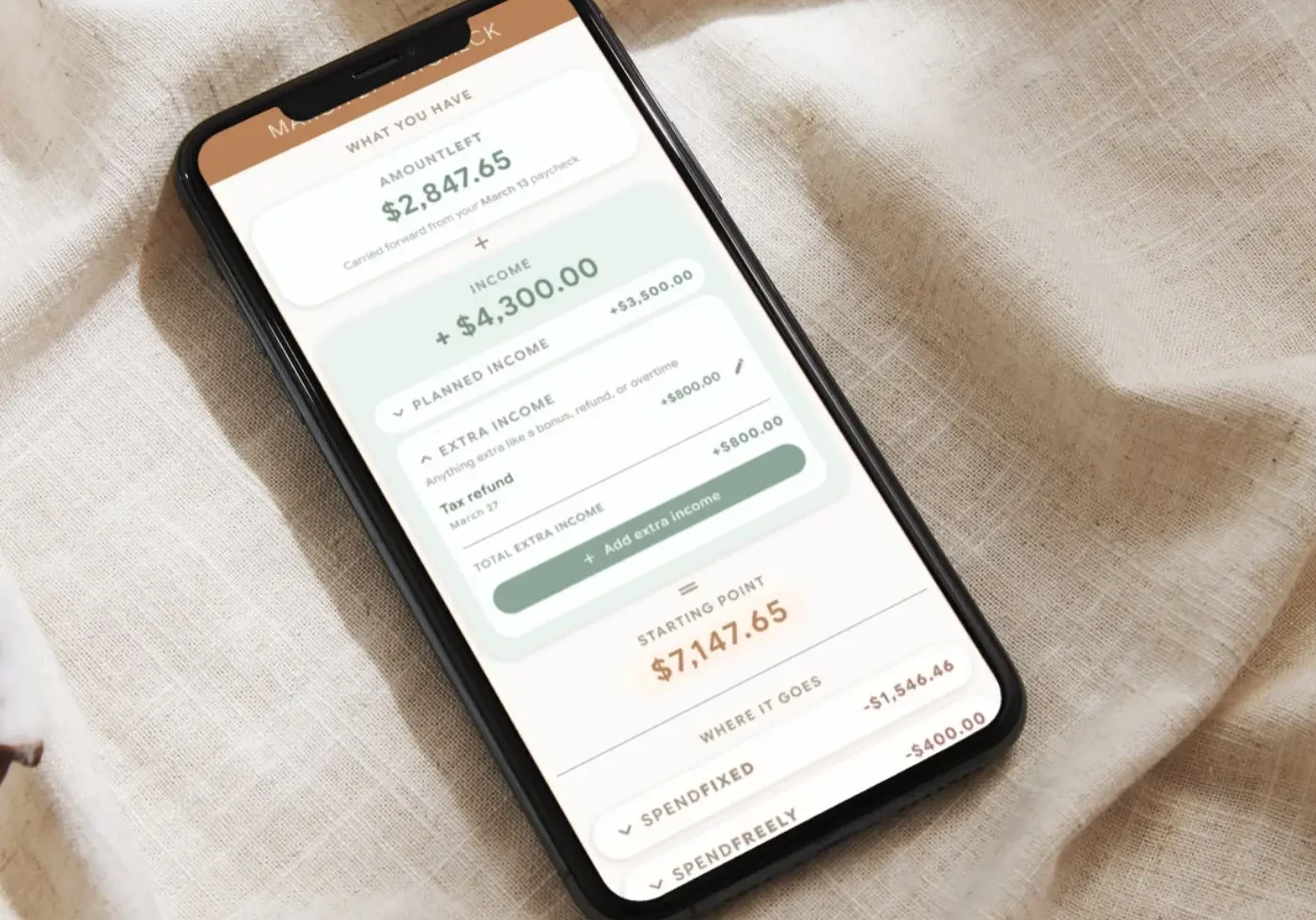
Your money already moves in three waves, and the whole thing works because SpendFixed, SpendFreely, and SpendFuture stay separate. That line blurs fast when one card is covering more than one wave. So give each card a wave and let the boundaries hold.
One card per wave. A SpendFixed card, a SpendFreely card, a SpendFuture card. You think about your money the same way you already do, and you reach for whichever card matches the wave.
Only have one card? Give it to SpendFuture, the easiest wave to start with, for reasons that will make sense in a minute.
Have five cards? You do not need to close four of them. Choose which cards have a job. The rest can sit in a drawer.
Pay the card every payday
Pay on your rhythm and the statement is never a surprise. It shows up, you glance at it, you already knew what it would say.
At your payday check-in, pay the card for the previous pay period’s spending, right then, rather than waiting for the statement or the due date. The money keeps moving in real time, and you never carry a balance or pay a cent of interest.
There is a second thing this fixes, and most people have never had a name for it. When you pay a card on the card’s schedule instead of yours, you end up running a month behind: paying for last month with this month’s income. If you have ever felt like you were working hard and somehow never catching up, that may be what you were feeling. Paying every pay period is how you climb back to even.
Begin with SpendFuture
Here is why SpendFuture is the simplest place to start. That money is already saved and already spoken for, so using a card there changes nothing about your week.
Your car breaks down. You charge the repair, then transfer the money out of your car savings account to pay the card. You want to book plane tickets. You charge them, then transfer the funds from your travel savings to pay the card. The money was always there. You ran it through the card and paid the card back from savings a few days later.
Personally, I prefer using my credit card when I shop for clothes. Before I go, I check my clothing fund and see how much I have available. Then I might hit six different stores, spending a different amount at each one. I keep a pulse on what I am spending while I am out. When I get home, I add up the total and transfer that amount from my clothing fund to pay the card. Simple.
Notice what is missing from that afternoon. No running total in the back of my mind, no wondering, no bracing for the statement. That is the part worth having.
Are rewards credit cards worth it?
If you are sure your rewards card is paying off, two questions. How does your program work? And when did you last redeem anything? Your answers usually tell you more than any comparison chart will.
The points are real, and they are also small. One to five percent. The trouble is that chasing points can push your own spending up before the card ever pays you back, and it does not take much of a bump to erase a two percent return. If the rewards nudge your grocery number up by more than the reward returns, you paid for the privilege of earning it.
Travel rewards deserve their own look, because the numbers sit further apart than they appear. A free flight starts around 25,000 miles. If your monthly expenses are $2,000 and half of that is a rent or mortgage payment you cannot put on a card, ask yourself how many months of spending that adds up to. Then add the redemption fees, the blackout dates on the weekend you wanted, and the fact that airlines can change how the program works without telling you.
A rewards card makes a fine small bonus on top of a system that already works, not a reason to build the system differently.
Two things to know before they happen to you
Neither is a big deal if you see it coming.
Some purchases count as cash advances. Money orders, cashier’s checks, lottery tickets, gambling chips and the like get classified by your card issuer as a cash advance. Cash advances usually carry a higher interest rate and their own fees, so it is good to know before you reach for the card at the counter.
Autopay is attached to the card number. A new card means updating every account by hand, and those auto-charged bills can break the day the old card is lost, stolen, replaced, or expires, usually while something is already past due. If you run bills through a card for the points, put the expiration date in your calendar so you update on your own schedule instead of after a declined payment.
If you are carrying a balance right now
You might be reading this with a balance already on the card.
Think about what your debt made possible. Maybe it paid for the car that let you take the job that changed your trajectory. Maybe it got you through a season where you were holding yourself and everyone else together. Maybe it funded a degree, a move, a moment, a goodbye, or a beginning.
And then there’s the cookware. Before Michael and I were even married, we put thousands of dollars of high-end cookware on a credit card. Which might make sense for some people, but neither of us cooks. To this day, I cannot tell you what we were thinking. But we made the payments and those pots outlasted the debt by about fifteen years. Not every financial decision has a noble origin story. Some of them are just cookware.
You do not have to love your debt. You do need to stop hating yourself for it. Did you do the best you could with what you knew at the time?
Now the practical part. What breaks the credit card cycle?
Most people assume the answer is sending every spare dollar at the balance. If you have tried that, you know what happens next. You pay $500, feel good about it, and two weeks later the car needs $500 of repairs that go straight back on the card. Same balance as before, plus interest on a car repair.
So the money has two jobs at once. Some goes to the card. Some goes into savings for the expenses you already know are coming. It looks slower on paper, and it is the version that holds.
A client named Jessie made this point better than I can. Every month, she threw every extra dollar at their credit card balances, proud of the big payments. It felt like progress. Then life would happen, a car repair, an unexpected business expense, and it went right back on the card. As she put it, “I would overpay so much. Here I thought I was making great strides in paying off our debt, and then I would just turn around and have to reuse it anyways.”
When Jessie and her husband Joe started working with me, the hardest thing I asked them to do was stop paying extra on the cards for a little while. For someone who had been throwing every spare dollar at the debt, that felt backward. But we needed to see the whole picture before we could build a plan that held.
Six months in, it shifted for good. “We have not used credit cards since we started our financial coaching,” Jessie told me. “We had a lot of big expenses come up in our life in the last seven months, and we were ready for all of them.”
Which payoff method fits you is a different question, and there is a better tool for it than a paragraph here. The free Debt Payoff Personality Quiz points you toward the approach that suits how you work, and there are setup guides, bank recommendations and the Year-at-a-Glance Planner there too. When you get your result, pick the one that excites you. Pick the one that makes you think, “I can do this.”
One card-specific note while you are deciding. A zero percent balance transfer can help, and it carries two traps. Interest is a motivator for some people, and when it disappears the urgency can go with it. And a transfer usually lowers your minimum payment, so if you drop to the new minimum the payoff takes longer than it would have. Two questions before you transfer: will you stay motivated once the interest is gone, and will you keep paying the old amount so more of it goes to principal? If yes to both, write the payment amount down and hold it there.
Where this leaves you
Set it up once, pay it at every payday, and a credit card goes back to being a piece of plastic that moves money you already had.
No statement dread. No running total in the back of your mind. You spend on the things you planned for, you take the points, and the number in your head matches the number on the screen.
That is how to use credit cards without going into debt, and it is the same thing that lets you stop living paycheck to paycheck in the first place.