And the number that actually tells you where you stand
You check your bank account. It says $2,340.
You feel okay about that… maybe even a little relieved.
Then you remember: rent comes out Thursday. The car payment hits Friday. You owe your phone bill, and you just remembered you said you’d split the birthday dinner this weekend.
Suddenly $2,340 doesn’t feel like $2,340 anymore.
You already knew this, because you’ve lived this. And yet every time you check your account, you go through the same mental math… trying to reverse-engineer what’s real from a number that was never designed to tell you.
Your bank balance isn’t lying on purpose. It just doesn’t know what you know.
It doesn’t know rent is due Thursday but just hasn’t cleared yet. It doesn’t know about the birthday dinner. It sees what cleared and that’s it. It shows you today and everything before today. You’re the one holding all the information about what’s coming, and doing the math alone, in your head, every single time.
That’s exhausting, and it’s not a discipline problem – it’s a visibility problem.
Why traditional budgets don’t fix this
Most budgeting tools are built around the calendar month. Your income arrives on the 1st, your expenses sort into categories, and at the end of the month you review what happened.
But that’s not how your life works. It doesn’t solve what we just described.
Your income arrives in paychecks: every two weeks, twice a month, sometimes weekly.
Your expenses hit on random days.
Some months have three paydays, some have two.
Some bills land mid-period and others cluster at the beginning.
When you try to apply a monthly system to a paycheck life, you spend a lot of time doing math that the system should be doing for you. And when the math lives in your head instead of somewhere you can see it, every financial decision carries more weight than it should.
Can I afford this? You’re not sure. So you either say no to things that were actually fine, or you say yes and find out later that it wasn’t.
The specific moment this becomes a problem
Here’s the scenario most people recognize immediately:
You have $3,200 in your checking account. You need groceries. You’re wondering if you should also grab that thing you’ve been putting off for weeks.
$3,200 sounds like enough. But is it?
If your electric bill is auto-drafting tomorrow and your rent clears Friday, you’re not looking at $3,200. You’re looking at something closer to $245…and you had no way to know that from glancing at your balance.
This isn’t a rare edge case. For most people, this is just Tuesday.
You don’t need more money. You need to see the money you have — clearly, before you make a decision, not after.
What changes when you can see AmountLeft
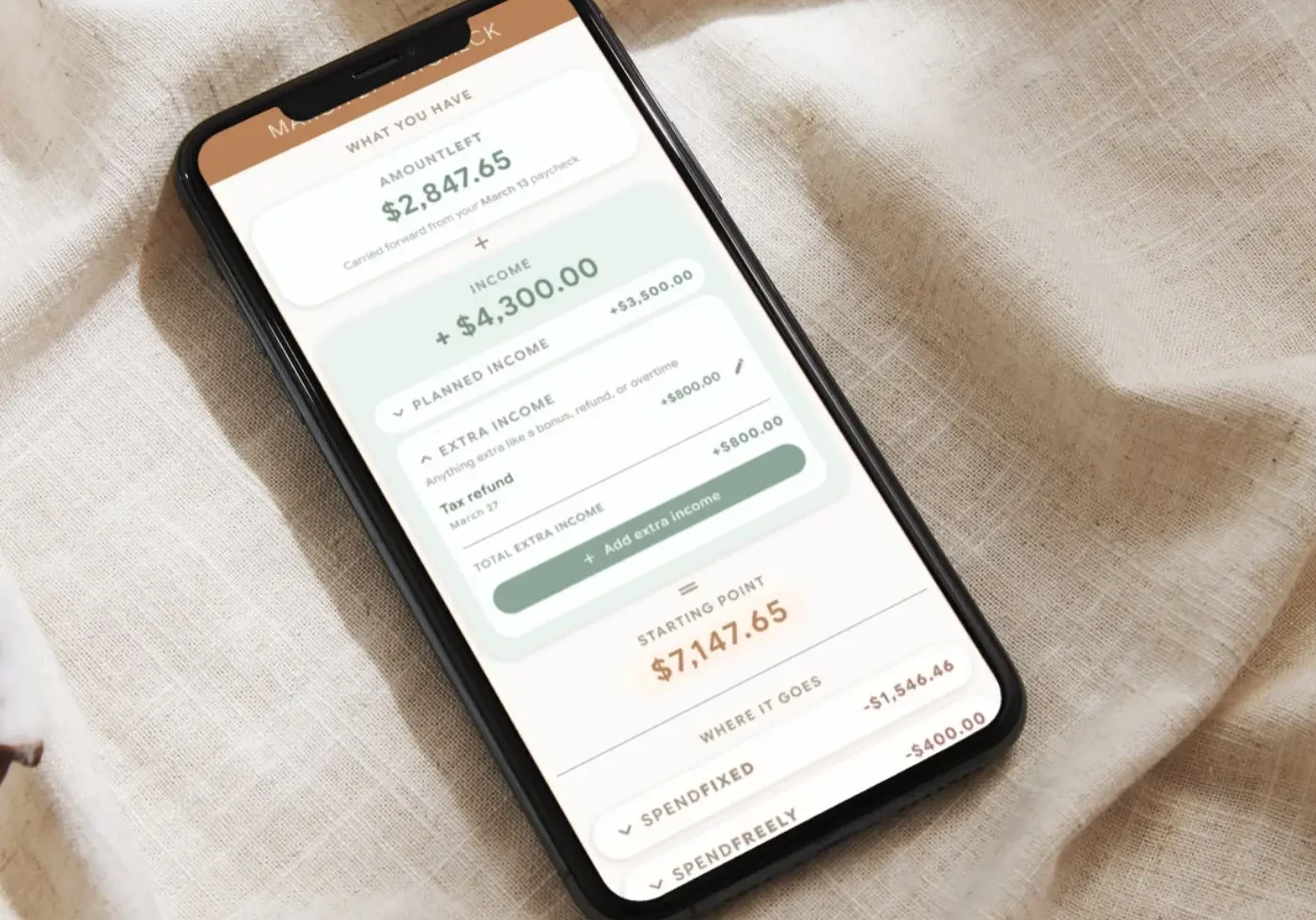
SpendFirst is built around a single number: AmountLeft.
Not your bank balance. AmountLeft is what will actually be in your checking account after everything that’s committed to this paycheck clears — bills, subscriptions, transfers, all of it.
It’s a forward-looking number. It tells you where you stand before you make a decision (not after you’re already looking at an overdraft or wondering why your account looks lower than expected).
When you know AmountLeft, the mental math stops. You stop reverse-engineering your own finances from a balance that was never designed to answer your actual question.
The decision becomes simple: here’s what’s available. Here’s what I’m considering. Yes or no.
That’s not a budgeting trick. That’s clarity… and clarity changes how you feel making decisions with your money.
Kelsa works through it with real numbers in Chapter 8 of the podcast, which answers the question directly: how much money should I have left after bills.
The three movements behind AmountLeft
SpendFirst organizes money into three movements. Not categories, not buckets, not envelopes. Movements. Because money moves. The flow of your money is a key tenet of SpendFirst.
- SpendFixed. Your committed monthly expenses: bills, subscriptions, anything with a due date. This is SpendFixed.
- SpendFreely. Your everyday spending: groceries, gas, dining out, the things that flex with real life. This is SpendFreely.
- SpendFuture. The expenses you know are coming but that don’t hit every month: car registration, holiday gifts, home repairs, the things that feel like surprises even when they aren’t. This is SpendFuture.
Once your money is mapped this way (by paycheck, not by month) AmountLeft emerges naturally. You can see it, trust it, and you can make decisions from it.
No spreadsheet required or tracking every dollar. Just a clear picture of where you actually stand.
With AmountLeft, you can see what’s available for the pay period you’re in. To see what’s left across a whole month, once your bills, your everyday spending and your irregular expenses are all funded, you look at your SpendFlex.
Credit cards work inside this same system, as long as you only charge what you’ve already set aside and pay the card each payday. Here’s how to use credit cards without going into debt.
This is not about having more money
People assume that feeling better about money requires earning more. Sometimes that’s true. But most of the stress people carry about money isn’t about the amount; it’s about the uncertainty.
Not knowing if you’re okay.
Not being sure if you can afford the thing.
Holding your breath until payday and then exhaling for a day before the cycle starts again.
That uncertainty doesn’t go away when income goes up, not if the system stays the same. You just worry about different numbers.
What actually reduces the stress is being able to see clearly. Knowing what’s committed, what’s free, what’s coming. Knowing your AmountLeft.
Once you can see it, you stop bracing… you stop second-guessing. You start making decisions with the confidence that comes from actually understanding your own money.
That’s what SpendFirst is for.
Ready to see your money clearly?
SpendFirst.com/start has everything you need to get set up: guides, tools, bank recommendations, and the SpendFirst app. It takes less time than you think, and it changes more than you’d expect.