If you’ve ever stood at the checkout watching the total climb and thought, “I really need a grocery budget,” you’re not alone. Groceries are one of the first places people look when money feels tight, because you’re at the store so often and the receipt is right there in your hand. The trouble is that a grocery budget expects every week to look the same, and yours probably doesn’t. Some weeks you cook every meal at home because your calendar is calm and you have the energy for it. Other weeks your schedule explodes and the drive-through becomes survival, not luxury.
How much should I spend on groceries?
Most answers to this question come back as a number someone else picked: a percentage of your income, or an average for a household your size, whether you’re shopping for one or working out a grocery budget for a family of 4. Those numbers tell you what other people spend. They can’t tell you what your weeks look like.
I’ll tell you something that surprises people when they hear it: I have no idea how much Michael and I spend on groceries versus eating out. I couldn’t give you the number. What I do know is our SpendFreely number. I know it works, and I know we’re hitting our goals. That’s my benchmark.
The more useful question is how much do you need for everyday life between one paycheck and the next, and groceries are one part of that.
Why a separate grocery category is so hard to keep
Think about the last time you went to the store for dinner ingredients. While you were there, maybe you grabbed socks for the kids because they’d outgrown the last pair, tossed in dog food because you were out, and added a candle you’d been eyeing because it was finally on sale. That’s one trip and four “categories,” but in your life it was just Tuesday.
A traditional budget splits that trip into groceries, kids, pets and personal spending, and then you’re standing in the aisle negotiating with yourself about whether you’re “allowed” to put the candle in the cart. Do that every time you shop and it’s no wonder so many people feel like they keep failing at a grocery budget.
Set one everyday spending number instead
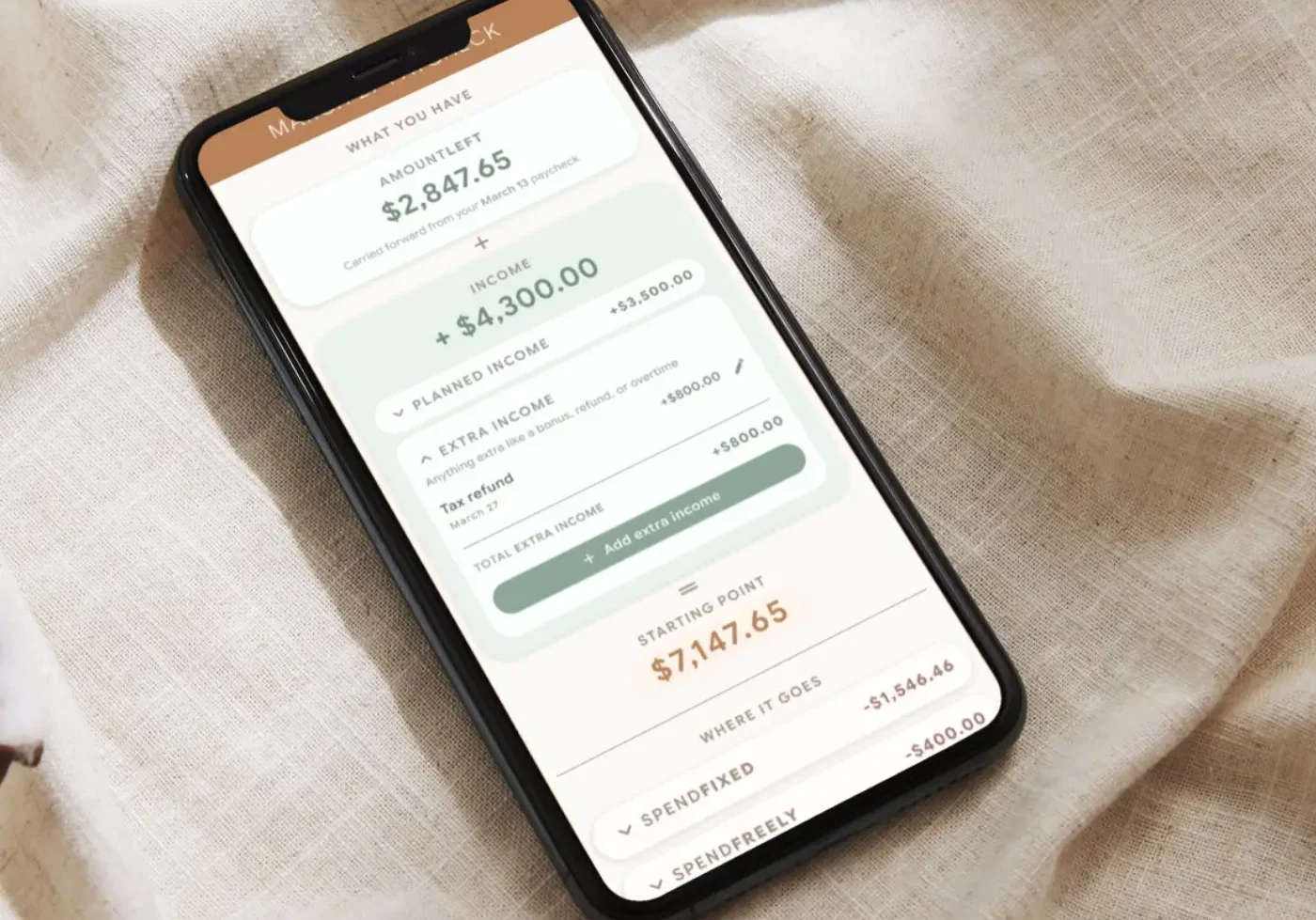
In SpendFirst, groceries live inside SpendFreely, the one number that covers everyday life: groceries, gas, eating out, household goods and the coffee runs. Instead of a grocery line, a dining line and a household line competing with each other, you manage all of it as one picture. Here’s how to set your starting number.
- Pick a weekly amount. Ask yourself how much you usually need, in a typical week, for everyday life. You’re not calculating an exact average, just aiming for a number that feels doable. If it helps, glance at the last month or two of spending to get a feel for it. If looking back feels heavy, skip it.
- Match it to how you’re paid. If you’re paid weekly, use that number as is. If you’re paid every two weeks or twice a month, double it. That’s how you budget by paycheck instead of by the month.
- Give it its own account. Each payday, that amount moves into a separate checking account you spend from every day. Standing in the store, you look at one balance and know where you stand. Here are some banks that make this easy.
- Live with it before you change it. Give it a few pay periods and see how it feels before you decide anything needs to change.
I can’t tell you how many times someone has come to me convinced they need to cut back on their spending, and when I ask how much they’re actually spending, they don’t know the number. That’s why we start by living with the number first. Then you can decide if changes are actually needed.
How to save money on groceries without hating it
Once you can see your number, you may decide you want to bring it down. This is where most people go too far. Say you’re spending $800 a month on groceries and decide to cut to $600. You meal plan aggressively, buy the cheapest options and skip the foods you really like to cook because they cost more. For a while it works, and you feel proud. By month three you’re miserable, your family is complaining, and you go back to $800 feeling like you failed.
Now imagine cutting to $700 instead. It’s only $100 a month, which looks worse on paper, but it feels doable, so you stay with it. Twelve months later you’ve put $1,200 toward your goals, compared with the $600 you saved before you quit the bigger cut.
A few things make the smaller cut easier to keep:
- Plan on the calm weeks. When your calendar allows it, meal plan on Sunday, go to the store with an organized list and prep food ahead.
- Expect the busy weeks. When someone is traveling, practices run late or everyone has a cold, takeout comes out of the same number. Over a few weeks it evens out.
- Check your balance before you shop. One look at your SpendFreely balance tells you how much room you have, so you can decide in the store instead of finding out later.
- Adjust somewhere else in the week. A dinner out can mean leftovers for lunch the next day or skipping the coffee run on Thursday.
Do you need to stop eating out?
Not necessarily. Eating out comes from the same SpendFreely number as groceries, so the decision becomes how you want your week to go, rather than whether a dining category has room left in it. Some weeks that means cooking every night. Other weeks it means takeout between commitments, and that’s part of real life.
When some weeks cost more
Some pay periods will cost less than your number, and a cushion builds. Others will cost more, and that cushion helps absorb it. You’re not expected to get this perfectly right at first. Over time, funding it consistently every payday matters more than the exact number.
Groceries are one piece of everyday spending. To see how they sit next to your bills and the costs that don’t come every month, start with fixed vs variable expenses. When every part of your money has a place, including the part you spend at the grocery store, that’s how you stop living paycheck to paycheck.
Set up your SpendFreely number in about 20 minutes. The free Quick Start Guide walks you through it.
SpendFreely, the everyday spending number, is Chapter 5 of SpendFirst.